Power is the part of a live camera that decides whether it is still streaming next winter. A good camera on bad power drops out on cold nights, reboots when the sun goes behind a cloud or dies when the battery ages. The good news: a fixed IP camera uses very little energy, often less than an LED bulb. The challenge is delivering that small amount reliably, all day, every day.
Know your load first
Every power decision starts with how much the camera uses. Makers list an average and a maximum. The AXIS M1135-E Mk II, for example, lists 4.4 W average and 6.6 W maximum. Infrared at night, heaters in winter and PTZ motors raise the figure. Then add everything else that must stay on: the router, a radio link or a satellite dish.
That chart explains most off-grid power decisions. A camera with a cellular router is a small solar job. Add a satellite dish and you need several times the panel and battery. See internet for remote cameras.
Option 1: PoE, the default choice
Power over Ethernet sends DC power down the same cable as the data. A PoE switch or a small injector (also called a midspan) indoors powers the camera outside. The IEEE 802.3 standards set the power levels and limit the cable channel to 100 m (328 ft).
| Standard | Common name | Power at the source | Power at the camera | Typical use |
|---|---|---|---|---|
| IEEE 802.3af (Type 1) | PoE | 15.4 W | 12.95 W | Fixed bullet, dome and box cameras |
| IEEE 802.3at (Type 2) | PoE+ | 30 W | 25.5 W | Cameras with IR or small heaters, small PTZs |
| IEEE 802.3bt (Type 3) | PoE++, 4-pair | 60 W | 51 W | PTZ cameras with heaters |
| IEEE 802.3bt (Type 4) | PoE++, 4-pair | 90 W | 71.3 W | Large PTZ, multi-sensor cameras |
The difference between the source and camera columns is the allowance for loss in the cable. Check your camera’s PoE class and maximum power on its spec sheet, and check the switch’s total PoE budget when you power several cameras.
Why PoE wins: one cable, low voltage that is safe to handle, central backup (one UPS at the switch keeps every camera alive), and the ability to reboot a camera remotely by cycling its switch port. The catch is the 100 m limit; beyond it, use a PoE extender, a fiber link with media converters or a local power source. See PoE cameras.
Option 2: Low-voltage DC (12 V or 24 V)
Many cameras also accept 12 V DC from an adapter. That works well for short runs, for cameras in a cabinet next to their power supply, and for solar systems that run on 12 V. The problem is voltage drop: low voltage over a long, thin wire loses a lot. At 12 V, a few watts over 30 m of thin wire can arrive too low for the camera to start. Keep DC runs short, use thick enough cable, or use a PoE injector at the battery end and let the network cable do the long run.
Low-voltage wiring still has rules. In the US, the National Electrical Code (NFPA 70) treats most of it as limited-energy (Class 2) circuits with their own requirements, and it has specific rules for large bundles of PoE cables because they warm up. The power supply that plugs into the mains, and any new outdoor outlet, should be installed by a licensed electrician: the NEC requires GFCI protection and weather-resistant in-use covers for outdoor receptacles in wet locations.
Option 3: Solar
Solar makes sense where no power is within reach, or where trenching would cost more than a panel and a battery. A 24/7 solar camera system has four parts: the panel, a charge controller (preferably MPPT, which squeezes more energy from the panel), a battery and the loads, often with a PoE injector or booster that turns 12 V into PoE.
The key is sizing for the darkest month, not the average. A camera and router drawing about 8 W together, about 220 Wh a day once conversion losses are added, need a panel of roughly 55 to 65 W in Miami, Phoenix or Denver in December, but around 170 W in Seattle or London, and far more in Alaska. Our solar sizing guide works through these numbers with NASA sunlight data.
Option 4: Battery only
A battery on its own runs out. The Reolink Go PT Ultra, for example, has a 21.6 Wh battery. At a continuous 4.4 W, that would last under five hours. That is why battery cameras sleep and wake on motion, and why the maker says battery life varies with settings and use. Battery-only power suits event cameras, temporary installs and wildlife cameras, not 24/7 live streams. Swappable batteries or a generator can bridge a weekend event, but not a season.
The four options compared
| PoE | Low-voltage DC | Solar + battery | Battery only | |
|---|---|---|---|---|
| 24/7 live stream | Yes | Yes | Yes, if sized for winter | No |
| Max distance | 100 m per run, extendable | Short; voltage drop | At the camera | At the camera |
| Cables | One for power and data | Power plus data | Short local wiring | None |
| Backup | Easy: UPS at the switch | UPS or battery at the supply | Built in: days of autonomy | Built in, short |
| Up-front cost | Low | Low | Medium to high | Low |
| Upkeep | Almost none | Almost none | Clean panel, battery replacement | Recharging, replacement |
| Best for | Most cameras | Short runs, cabinets, 12 V systems | Remote sites | Events, wildlife, check-ins |
Working out your daily load
Whatever power you choose, write the load down. Multiply each device’s average watts by the hours it runs, add them up, then add 10 to 20 percent for conversion losses (DC converters, PoE injectors, the charge controller). Here is a typical remote camera:
| Device | Average power | Hours a day | Energy a day |
|---|---|---|---|
| Fixed PoE camera (AXIS M1135-E Mk II figure) | 4.4 W | 24 | 106 Wh |
| 4G router at its maximum (Teltonika RUT241 figure, about 3.3 W) | 3.3 W | 24 | 79 Wh |
| Subtotal | 7.7 W | 185 Wh | |
| Plus about 15% losses | about 215 to 220 Wh |
Using the router’s maximum rather than its typical draw builds in a margin. For a PTZ camera, use the maker’s figure with heaters and motors in use, because winter nights are exactly when the solar budget is tightest.
Which option for which site?
- Building with power and network: PoE from the switch, UPS in the cabinet. Done.
- Outbuilding 60 m away with power: PoE from the main building if the cable run is under 100 m; otherwise a small switch powered in the outbuilding.
- Pole in a field 300 m from power: compare the cost of trenching power against a solar system. Over a few hundred meters, solar often wins.
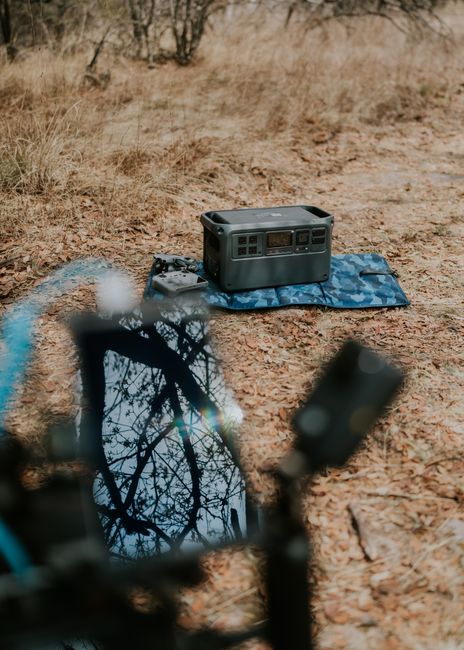
- Weekend event or wildlife nest: a battery camera or a portable power station, recharged between uses.
- Mountain top with no power and no cable route: solar sized for winter, with extra battery days for storms, and a low-power internet link.
Backup power and surge protection
- UPS. A small uninterruptible power supply at the switch and router keeps the stream alive through short outages. Size it for the PoE load plus the router, and replace its battery every few years.
- Surges. Outdoor cables pick up surges from nearby lightning. Fit Ethernet surge protectors where outdoor cables enter the building and at the base of tall poles, bonded to ground.
- Grounding. Metal poles, masts and dish mounts must be bonded to the building’s grounding system to code. That is electrician’s work.
- Remote reboot. A managed PoE switch, or a smart relay on a solar system, lets you power-cycle a frozen camera without a site visit.
Parts that fit each option
Specs below are the makers’ own, from their product pages. Price checked 2026-10-07 on the maker’s store.
TP-Link POE150S Omada PoE Injector
- IEEE 802.3af compliant
- Gigabit data
- Plug and play, no configuration
Victron SmartSolar MPPT 75/15
- MPPT charge controller, 75 V PV input, 15 A charge
- Built-in Bluetooth monitoring
- Load output with programmable cut-off
Battle Born 100Ah 12V LiFePO4 Deep Cycle Battery (BB10012)
- 12 V, 100 Ah lithium iron phosphate
- Group 27/31 drop-in size
- $799 sale price at Battle Born, checked 2026-10-07
Lithium (LiFePO4) batteries should not be charged below freezing unless they have built-in heating or the charge controller has a low-temperature cut-off. Check the battery maker’s limits for cold sites.
Do these next
- Size a solar system for your latitude and season.
- Pick the internet link, and add its power to your load.
- Price it all before you buy.
Questions people ask
What is the best way to power an outdoor camera?
PoE whenever a cable can reach it. One Ethernet cable carries power and data up to 100 m, and a UPS at the switch backs up every camera at once.
How much power does an IP camera use?
Most fixed cameras use a few watts. The AXIS M1135-E Mk II lists 4.4 W average and 6.6 W maximum, about 106 Wh a day. Infrared, heaters and PTZ motors add more.
How far can PoE run?
The IEEE standards allow a 100 m (328 ft) channel. For longer runs use a PoE extender, a fiber link or a local power source.
Can I run a 24/7 live camera on a battery?
Not on its own. A small camera battery lasts hours, not days, at continuous use. A 24/7 camera needs mains, PoE or a solar system sized for winter.
Is passive PoE the same as PoE?
No. Passive PoE puts a fixed voltage on the cable without negotiation. Standard IEEE PoE negotiates power first. Mixing them can damage equipment.
Sources
- IEEE P802.3bt DTE Power via MDI over 4-Pair Task Force (checked 2026-10-07)
- AXIS M1135-E Mk II specifications (power) (checked 2026-10-07)
- Teltonika RUT241 power consumption (checked 2026-10-07)
- Starlink Mini specification sheet (checked 2026-10-07)
- Starlink Standard specification sheet (checked 2026-10-07)
- NFPA 70, National Electrical Code (checked 2026-10-07)
- TP-Link POE150S product page (checked 2026-10-07)
- Reolink Go PT Ultra specifications (battery) (checked 2026-10-07)
Last reviewed October 7, 2026 by the LiveLocation team. General information, not legal or electrical advice.