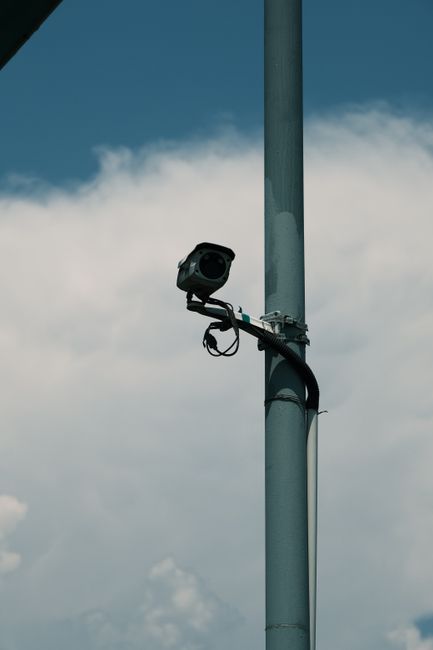
Most failed webcams do not fail because of the camera. They shake in the wind, fill with water, go dark every winter afternoon or run out of data halfway through the month. Mounting and power are the unglamorous part of a live camera, and the part that decides whether it is still streaming next year.
Start with where the camera goes, then how it is fixed, then how it is protected, powered and connected. Electrical work, roof work and tall poles carry real risk: we say clearly when a licensed electrician or installer is the right call.
The guides in this section
Mounting on wallsBrick, concrete, wood, siding and stucco: anchors, junction boxes and sealing.
Mounting on polesPole sizes, steel straps and clamps, wind and vibration.
Weatherproofing and IP ratingsIP65 to IP68 and IK10 explained, plus drip loops and cable glands.
Powering a cameraPoE, low-voltage DC, solar and battery compared.
Solar sizing step by stepPanel and battery sizes from real sunlight data, by latitude and season.
Internet for remote cameras4G/5G, point-to-point Wi-Fi and Starlink compared.
If you are still choosing the camera itself, start with the choosing a camera guides, then come back here. If the camera is already up and streaming, jump to stream your own camera to share it.
The order that saves money
| Step | Decide | Typical mistake |
|---|---|---|
| 1. Spot | Height, direction, what is in frame | Facing the sunset; too low, so people fill the frame |
| 2. Fixing | Wall, pole or roof; anchors and mount | Plastic plugs in crumbly brick; mounts that vibrate |
| 3. Protection | IP and IK rating, sealing, drip loop | Water running down the cable into the connector |
| 4. Power | PoE, DC, solar or battery | Undersized solar that dies every December |
| 5. Internet | Wired, 4G/5G, radio link or satellite | A data plan that runs out mid-month |
Do these next
- Find the right spot with the field-of-view table.
- Choose the power and, if off-grid, size the solar.
- Share your camera on LiveLocation when it is live.
Questions people ask
How high should an outdoor live camera be mounted?
For security, about 2.5 to 3 m is common. For a public webcam, higher is better: 6 m or more shows more of the view and keeps people unrecognizable.
What is the easiest way to power an outdoor camera?
Power over Ethernet (PoE): one outdoor-rated network cable carries both power and data up to 100 m from the switch or injector.
Can a live camera run on solar power all year?
Yes, if the panel and battery are sized for the darkest month at your latitude, not the yearly average. High-latitude winters need much bigger systems.
Sources
- IEC 60529 Degrees of protection provided by enclosures (IP Code) (checked 2026-10-07)
- NFPA 70, National Electrical Code (checked 2026-10-07)
- OSHA QuickCard: Portable Ladder Safety (checked 2026-10-07)
- NASA POWER solar and meteorological data (checked 2026-10-07)
Last reviewed October 7, 2026 by the LiveLocation team. General information, not legal or electrical advice.