Anchorage sunset live cam – Spurr (ANCW camera)
Working Still image · every 10 min Volcano · Official source · What camera types mean
What you are looking at
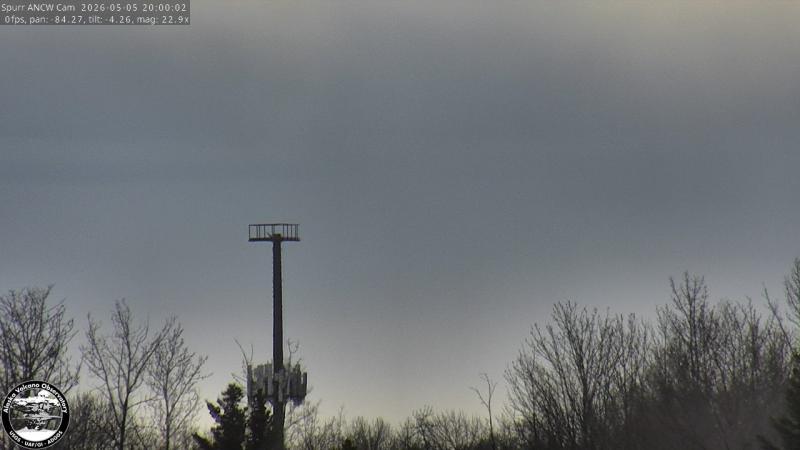
This ANCW camera is in Anchorage, about 45 m (150 feet) above sea level, and looks west across Cook Inlet toward Mount Spurr, about 128 km (80 miles) away. On clear days the frame shows Spurr's broad snowy summit and neighboring peaks of the Tordrillo Mountains rising above the far shore, with a light pole and bare trees in the foreground.
Spurr is the closest active volcano to Anchorage. Its flank vent, Crater Peak, erupted in 1992, dropping ash on the city and closing the airport. In 2024 and 2025, a period of unrest led the Alaska Volcano Observatory to warn that another eruption was possible. This camera gives a city view of the volcano that many Anchorage residents see from their windows. Check the AVO Spurr page for the current alert level.
The picture on this page is a still frame, renewed about every ten minutes. Sunrise light behind the camera can paint Spurr pink, and winter sunsets can silhouette it. Clouds, haze or snow showers often hide the volcano. Tip: an ash plume from Spurr would likely be visible from this camera on a clear day, so it is a good first check if you hear news of activity.
Camera details
- Camera ID
- Spurr_ANCW
- Operator
- Alaska Volcano Observatory (USGS)
- Name at the provider
- Spurr [ANCW, 148 ft]
- Volcano
- Spurr
- Volcano number (Smithsonian GVP)
- 313040
- Elevation
- 45 m / 148 ft
- Camera faces
- West (277°)
- Image updates
- Every 10 min
- Video format
- Still image (JPEG)
- Position
- Exact (from the provider)
- Licence
- U.S. public domain
- Data source
- USGS volcano webcams
- Working, last 7 days
- Not enough checks yet
From the provider's own camera list and our automatic checks. Readings and details can change without notice.
About Anchorage, Alaska
Weather now in Anchorage: 45 °F (7 °C), rain showers, wind 5 mph (8 km/h) from the north. Forecast for 7 PM local time. Weather: MET Norway (CC BY 4.0)
Anchorage is a city in Alaska, United States with about 290,000 people. The camera is about 3.1 mi from the center, 148 ft (45 m) above sea level. Anchorage keeps America/Anchorage time (UTC−8 at the moment); the panel above shows the local time live.
On the map
Live cameras near Anchorage
All Anchorage live cameras · Camera radar centered here · More from USGS volcano observatories
Questions about Spurr (ANCW camera)
Is Spurr (ANCW camera) working right now?
Yes, it is working: at our last automatic check it was sending new pictures. It is a still image, not video: a new photo arrives about every 10 minutes straight from Alaska Volcano Observatory (USGS).
Who operates the Spurr (ANCW camera) camera?
Alaska Volcano Observatory (USGS) runs this camera, as part of the U.S. Geological Survey (USGS) Volcano Hazards Program. It is an official source. Its images are in the U.S. public domain. LiveLocation shows them straight from the source with credit. About USGS volcano observatories Watch at the source
Where exactly is this camera?
It is about 3.1 mi from the center of Anchorage, Alaska, United States. Coordinates: 61.176, -149.866. All cameras in Anchorage
What is the local time at Anchorage?
Anchorage is in the America/Anchorage time zone. The "Right now" panel above shows the local time live. On October 7 the sun rises at 8:22 AM and sets at 7:12 PM there.
Are there more live cameras near Anchorage?
No other camera is within 25 miles yet. The live camera radar can search up to 250 miles around this spot. Open the radar here
Is this volcano erupting, and where is the official alert level?
Alaska Volcano Observatory (USGS) sets the U.S. Volcano Alert Level and Aviation Color Code for this volcano, not LiveLocation. Read its latest update before you plan a visit; the camera alone cannot tell you how safe it is. USGS volcano updates Official camera page
What are the conditions at Spurr (ANCW camera) now?
The latest readings from the provider: Volcano alert level: NORMAL · aviation code GREEN; Last USGS notice: Aug 22, 2025, 11:07 local time; Issued by: Alaska Volcano Observatory (USGS). They update with the provider's data, so they can be a few minutes old.