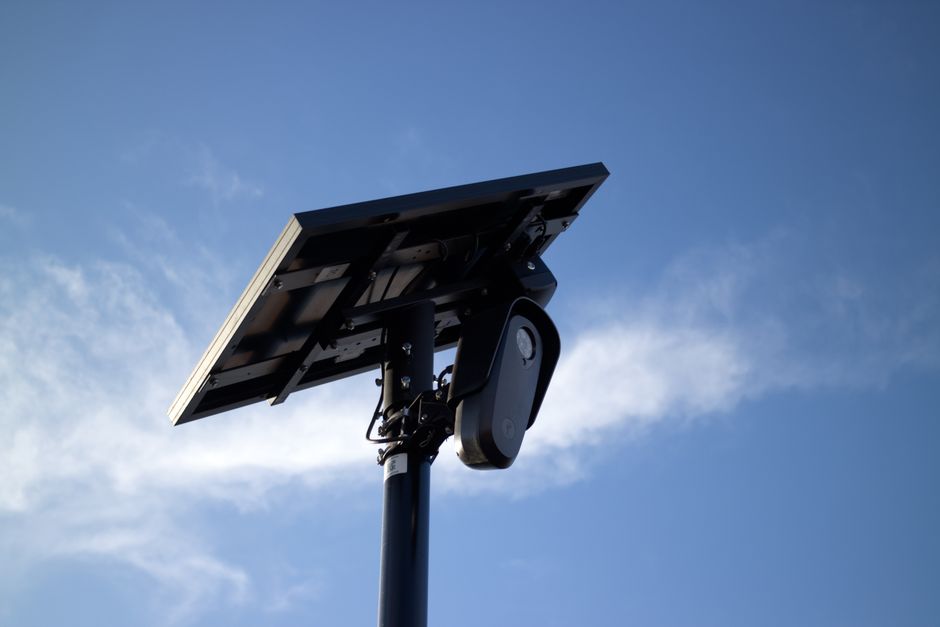
“Solar camera” covers two very different machines. One is a small battery camera with a phone-sized panel, sold for gates, sheds and driveways. The other is a full solar power system that keeps a normal IP camera and its internet link running day and night. Both are useful. Mixing them up is the most common reason solar cameras go dark in December.
This page explains the difference, the basic math for panels and batteries, and what to look for. When you are ready to size a real system, go to solar sizing step by step.
Two kinds of solar camera
1. Battery cameras with a small panel
These cameras sleep most of the time. A passive infrared (PIR) sensor watches for warm moving objects, and only then does the camera wake up, record a clip and send it over Wi-Fi or 4G. Live view works when you open the app. Because the camera is off most of the day, a panel of a few watts can keep it topped up. eufy, for example, says its SoloCam S340 gets all-day power from 2 hours of sunshine, and Reolink pairs its 4G Go PT Ultra with a 6 W panel and a 21.6 Wh battery.
Great for: watching a gate, a boat, a cabin door, a construction trailer. Not great for: a public webcam that streams nonstop.
2. Solar systems for always-on cameras
An always-on camera never sleeps. A typical fixed IP camera draws around 4 to 7 watts, more at night with infrared on. Add a 4G router (often 3 to 6 W) and you need 8 to 12 W around the clock. That is a different scale of power, which needs a proper panel, a charge controller and a deep-cycle battery, usually lithium iron phosphate (LiFePO4).
The basic math: three numbers
You only need three numbers to understand any solar camera setup:
- Daily energy (Wh/day): the power your equipment draws, in watts, times 24 hours. A 10 W camera and router use 240 Wh a day.
- Peak sun hours: how many hours of full-strength sunlight your site gets per day, on average, in its worst month. In much of the US this is around 2 to 3 in December and 5 to 7 in summer; it is lower in cloudy northern places. Free NASA POWER data gives solar energy for any location on Earth.
- Days of autonomy: how many dark, cloudy days in a row the battery must cover without any sun. Two to three days is common; five for critical cameras in cloudy climates.
Then:
- Panel watts ≈ daily Wh ÷ worst-month peak sun hours ÷ 0.7. The 0.7 covers losses from heat, dirt, angle, wiring and the charge controller.
- Battery Wh ≈ daily Wh × days of autonomy ÷ usable fraction. Use about 0.8 for LiFePO4, about 0.5 for lead-acid.
Worked examples
| Setup | Daily use | Panel at 2 sun hours (winter) | Panel at 4 sun hours | Battery for 3 days (LiFePO4) |
|---|---|---|---|---|
| Battery camera, motion clips | ~4 Wh | The maker’s panel (a few W) | The maker’s panel | Built-in |
| 24/7 fixed camera, 5 W, Wi-Fi to a building | 120 Wh | ~90 W, use 100 W | ~45 W, use 50 to 60 W | ~450 Wh (12 V 40 Ah) |
| 24/7 camera + 4G router, 10 W | 240 Wh | ~170 W, use 200 W | ~90 W, use 100 W | ~900 Wh (12 V 75 to 80 Ah) |
| PTZ with heater + router, 20 W | 480 Wh | ~340 W, use 2 x 200 W | ~170 W, use 200 W | ~1,800 Wh (12 V 150 Ah) |
These are rough first estimates for understanding, not an installation design. Shading, latitude, snow and very cold batteries change the answer. The full method, with tilt angles by latitude and a calculator, is on solar sizing step by step.
Batteries: what to know
- LiFePO4 (lithium iron phosphate) is the usual choice for always-on cameras: long life, many charge cycles and deep discharge. Most must not be charged below about 0 °C (32 °F) unless they have built-in heating; check the maker’s data.
- Lead-acid (AGM/gel) is cheaper up front, handles cold charging better, but is heavy and should not be drained below about half.
- Built-in packs in battery cameras are lithium-ion; heat in a sealed box in full sun shortens their life, so mount them in shade where possible.
Charge controllers: the small box that matters
In a full solar system, a charge controller sits between the panel and the battery. It stops the battery from overcharging in summer and, with a “load” output or low-voltage cutoff, stops the camera from draining the battery to damage in winter. There are two kinds:
- PWM controllers are simple and cheap. They work well when the panel’s voltage closely matches the battery’s, for example a “12 V” panel on a 12 V battery.
- MPPT controllers track the panel’s best operating point and convert extra voltage into extra current. They typically harvest noticeably more energy, especially in cold weather and low sun, which is exactly when a camera needs it. For anything over about 100 W, MPPT is usually worth it.
Pick a controller that matches your battery chemistry (LiFePO4 and lead-acid charge differently), and choose one with a low self-consumption so it does not eat into a small budget. Some controllers have a Bluetooth or network link so you can see battery voltage remotely, which is extremely useful for a camera you cannot visit often.
How battery cameras save power
Solar battery cameras last on tiny panels because they do very little most of the time. A PIR motion sensor uses almost no energy while it waits. When something warm moves, the camera wakes, records a short clip, sends it and goes back to sleep. Most of the energy is spent in those few seconds of video and radio use.
That is why settings matter so much. Shorter clips, fewer triggers, lower resolution for alerts and “live view only when needed” can double or triple battery life. And it is why these cameras rarely work as public webcams: a public stream is the opposite of sleep.
Wi-Fi or 4G with solar?
If the solar camera is within good Wi-Fi range of a building, Wi-Fi uses less energy than a cellular modem and has no monthly data fee. If there is no network nearby, 4G is the only practical choice, and the modem adds to the power budget. In an always-on setup, the 4G router is often as big a load as the camera itself, so count it. Our 4G/LTE cameras page covers data and coverage.
Panel placement
- Face the equator: south in the Northern Hemisphere, north in the Southern.
- Tilt steeply for winter: roughly your latitude plus 10 to 15 degrees, which also helps snow slide off.
- Avoid shade from trees, poles and buildings, especially between 9 a.m. and 3 p.m. Even a small shadow on one corner can cut a panel’s output a lot.
- Keep it clean: dust, pollen, bird droppings and salt spray reduce output. Coastal panels need wiping more often.
For poles and brackets, see mounting on poles. For weather and enclosures, see weatherproofing and IP ratings.
Solar battery camera vs full solar system
| Solar battery camera | Full solar system + IP camera | |
|---|---|---|
| Panel | Small, a few watts, often included | 50 to 400 W |
| Battery | Inside the camera | Separate box, 12 V or 24 V |
| Live view | On demand, short sessions | Continuous |
| Recording | Motion clips | Continuous or event-based |
| Install effort | Minutes | Hours to a day, often a pole and enclosure |
| Good for a public webcam? | No | Yes, when sized well |
Why solar cameras fail, and how to avoid it
- Undersized for winter. The number one cause. Size for the worst month.
- Too many live views. On a battery camera, every minute of live view uses as much energy as many motion clips. Family members leaving the app open drain it.
- Too many motion triggers. Trees, flags and traffic wake the camera all day. Adjust detection zones and sensitivity.
- Cold batteries. Lithium batteries lose capacity in deep cold and many cannot charge below freezing.
- Shade that moves. A spot in full sun in June can be in a building’s shadow in December when the sun is lower.
A good habit for any solar camera you care about: check the battery level in the app or controller once a week through the first winter. If it trends down day after day, add panel watts or cut the load before the first long storm, not after.
Solar cameras to look at
Both cameras below are battery cameras with solar panels, designed for motion clips and on-demand live view. Specs are as stated by each maker on the date shown at the end of this page.
eufy SoloCam S340
- Dual lens: 3K wide + 2K telephoto, 8x hybrid zoom
- 360° pan, 70° tilt
- Built-in solar, 8 GB on-device storage
Reolink Go Ultra
- 4K 8MP at 15 fps
- 4G LTE, Solar Panel 2 (6 W)
- 28 Wh battery, IP65
For an always-on camera, look at off-grid 4G + solar cameras, which covers complete systems.
Do these next
- Write down your devices’ maximum watts and multiply by 24.
- Size the panel and battery for your worst month.
- Choose a sunny, safe spot for panel and camera.
Questions people ask
How big a solar panel does a security camera need?
A motion-triggered battery camera usually needs only the few-watt panel its maker supplies. A camera that streams 24/7 at 5 W needs roughly a 100 W panel in a place with 2 winter sun hours, and twice that if it also powers a 4G router.
Can a solar camera stream live 24/7?
Only with a full solar system: a panel of about 100 to 200 W or more, a large battery and a charge controller, sized for the darkest month. Small solar battery cameras are designed for motion clips and short live views.
Do solar cameras work in winter?
Yes, if they are sized for winter sun hours and the battery can handle the cold. Many lithium batteries cannot charge below freezing, so cold sites need heated batteries or lead-acid.
Do solar cameras work on cloudy days?
They charge less, so the battery carries the load. That is why systems are sized for two to five days without sun.
Which way should a camera solar panel face?
Toward the equator: south in the Northern Hemisphere, north in the Southern. Tilt it steeply, around latitude plus 10 to 15 degrees, for better winter sun and to shed snow.
Sources
- NASA POWER: solar and meteorological data (checked 2026-10-07)
- eufy SoloCam S340 (checked 2026-10-07)
- Reolink Go PT Ultra specifications (6 W panel, 21.6 Wh battery) (checked 2026-10-07)
- Reolink Go Ultra specifications (28 Wh battery) (checked 2026-10-07)
- VOSKER V300 off-grid camera (14,000 mAh battery, built-in panel) (checked 2026-10-07)
Last reviewed October 7, 2026 by the LiveLocation team. General information, not legal or electrical advice.