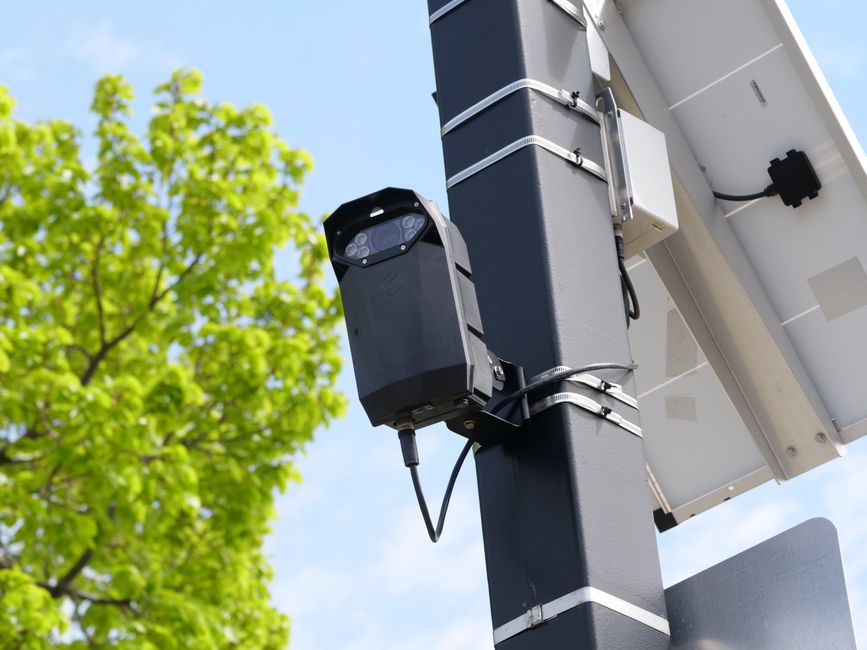
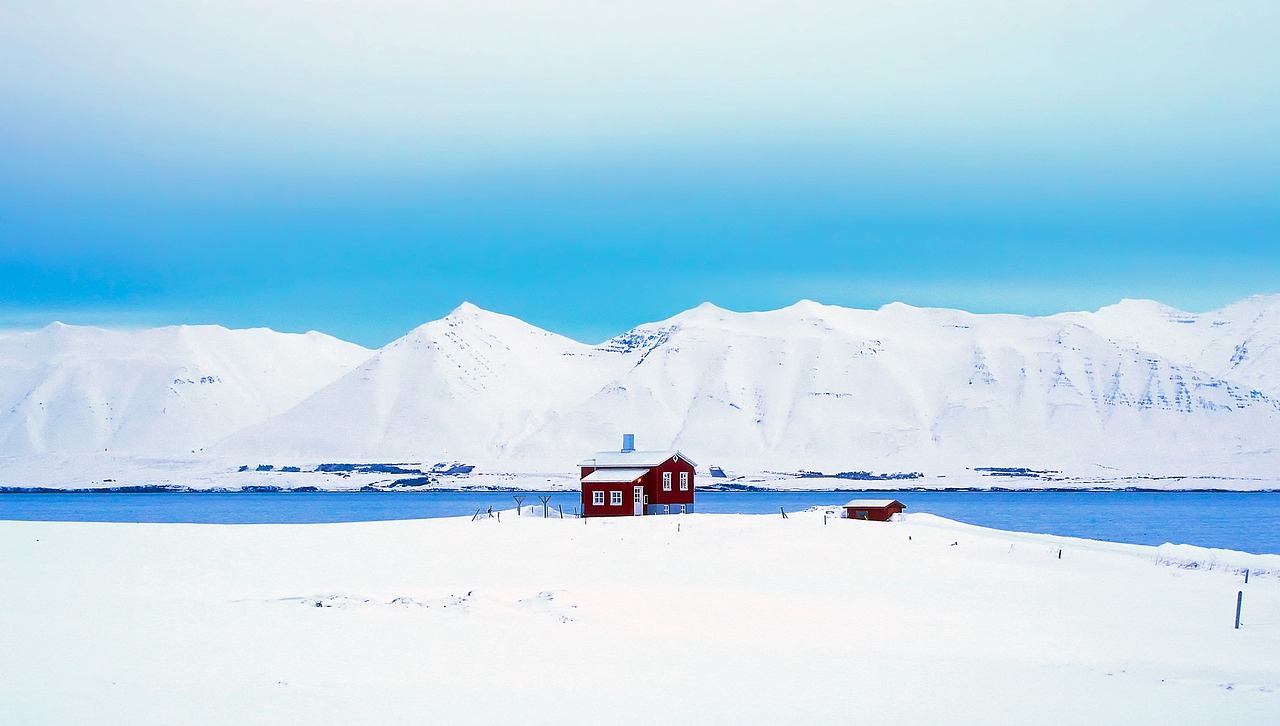
A gate two miles from the farmhouse. A cabin that is empty from October to May. A building site with expensive tools in a container. A trailhead where hikers want to see the snow line before they drive up. None of these has a power outlet or an internet line, and running cable would cost more than the camera. That is the job off-grid 4G + solar cameras were made for.
Off-grid cameras have become far more practical in the last few years. Panels are cheaper, lithium batteries last longer, cellular networks reach farther into the countryside, and cameras have learned to sleep until something happens. What used to need a technician and a generator can now be a weekend project.
This page shows the three ways to build one, from a box you screw to a post in ten minutes to a small power station on a pole, and how to pick the right one.
What makes a camera “off-grid”
Off-grid means two things are solved on site:
- Power: a solar panel charges a battery, which runs the camera (and router) day and night. See solar cameras.
- Internet: a cellular modem connects to the nearest 4G or 5G tower with a SIM card. See 4G/LTE cameras.
Everything else, from resolution to pan and tilt, is a feature choice. What really decides the design is one question: do you need to check in, or do you need to broadcast?
Three ways to build an off-grid camera
Option 1: All-in-one 4G solar camera
Camera, battery, modem and a small panel in one package. You add a SIM (often included), mount it, and it sends motion clips and alerts to your phone. You can open a live view whenever you want. Installation takes minutes, and monthly data is usually a few gigabytes.
Best for: farm gates, cabins, boat moorings, small building sites, checking that the snow has not crushed the shed roof.
The limits are worth knowing up front. The small panel and battery cannot support hours of live viewing every day, the camera cannot usually push a stream to YouTube, and the video goes through the maker’s app and cloud. If several family members leave live view open, the battery will tell you. For most private uses, none of this matters; for a public webcam, all of it does.
Option 2: Camera + 4G router + solar kit
A regular wired IP camera, a 4G router with external antennas, a charge controller, a battery and a 100 to 300 W panel, usually on a pole with a weatherproof box. It can record continuously to an SD card, stream all day, and be reached by its maker’s app or a VPN through the router. Because it is built from standard parts, you can swap a better camera or a 5G router later.
Best for: public webcams at trailheads, beaches and ski areas without power; construction time-lapse; any place where you want a real stream.
Option 3: Professional mobile surveillance unit
Trailer or mast units with several cameras, large solar arrays, big battery banks and often a backup generator or fuel cell. Rented or leased for construction sites, events and parking lots. Overkill for most people, but worth knowing about if you need several views for a few months.
The three options compared
| All-in-one 4G solar | Camera + router + solar kit | Mobile surveillance unit | |
|---|---|---|---|
| Install time | Minutes | Half a day to a day | Delivered and set up by the supplier |
| Panel | A few watts, included | 100 to 300 W | Several hundred watts and up |
| Live stream | On demand, short | 24/7 possible | 24/7, several cameras |
| Data per month | A few GB | Up to hundreds of GB | Large |
| Public webcam? | No | Yes | Rarely (security use) |
| Upgradeable | No | Yes, standard parts | Supplier-dependent |
| Theft risk | Easy to remove | Pole-mounted, lockable box | Built to resist |
Which option for which place
| Place | What people usually need | Good fit | Notes |
|---|---|---|---|
| Farm gate or barn | Alerts when a vehicle or person arrives | Option 1 | Aim at the gate, not the road beyond it |
| Livestock field or water trough | A quick look a few times a day | Option 1, PTZ model | Pan and tilt saves a second camera |
| Holiday cabin in winter | Snow depth, break-in alerts | Option 1 | Panel tilted steeply; check battery weekly |
| Construction site | Night security, progress time-lapse | Option 2 or 3 | Time-lapse can use snapshots, very little data |
| Trailhead or ski area without power | Public live view of conditions | Option 2 | Daylight-only stream halves the power |
| Marina or boat ramp | Public view or boat checks | Option 1 for checks, option 2 for a webcam | Salt air: stainless hardware, sealed glands |
A maintenance calendar
Off-grid cameras are low maintenance, not no maintenance. A simple rhythm keeps them running for years:
- Weekly in the first winter: glance at battery level in the app or charge controller. A steady decline means the system is undersized.
- Monthly: check that firmware updates are installed on the camera and router, and that the data plan usage looks normal (a sudden jump can mean a setting changed).
- Every season: clean the lens and panel, check for spider webs (they trigger motion alerts at night under IR), and look at cable glands and drip loops.
- Every year: tighten mounts after wind and frost, check the battery’s health, and review who has access to the app; remove old accounts.
- After big storms: clear snow or debris from the panel and confirm the camera came back online.
Sizing a 24/7 off-grid camera
For option 2, the power budget is everything. A simple example:
- Fixed IP camera, 6 W maximum with IR on, plus 4G router at 5 W: 11 W x 24 h = 264 Wh/day.
- Site in the northern US with about 2 peak sun hours in December: panel ≈ 264 ÷ 2 ÷ 0.7 ≈ 190 W, so a 200 W panel.
- Three cloudy days of autonomy with LiFePO4 at 80 percent usable: battery ≈ 264 x 3 ÷ 0.8 ≈ 990 Wh, about a 12 V 80 to 100 Ah battery.
- An MPPT charge controller rated for the panel and battery, with a low-voltage cutoff.
At a sunny southern site, the same camera may need half the panel. In cloudy northern Europe in winter, you may need more panel than you expect, or a schedule that turns the stream off at night. Our solar sizing page works this out by latitude and season.
Connectivity tips for remote sites
- Check signal at the exact spot and height, with a phone on the carrier you will use, in the evening when networks are busiest.
- Use external antennas on the router, pointed toward the tower. Directional antennas can turn a weak signal into a usable one.
- Pick a plan that allows the use. Some plans forbid routers or continuous streaming; others slow you down after a threshold.
- Plan a remote reboot. Many 4G routers can restart on a schedule or when the connection drops; some charge controllers can switch the load off and on.
- Lock it down. Change the router’s admin password, update firmware and do not open ports to the camera. Use the router maker’s VPN or cloud, or push the stream out to YouTube. See camera security.
Weather, theft and wildlife
Remote cameras face the elements alone. A few habits keep them alive:
- Mount high: at least 3 m (10 ft) on a pole or building, out of easy reach, with the panel tilted steeply to shed snow.
- Use a lockable, ventilated enclosure for the battery and electronics, rated for outdoor use. Batteries do not like heat; shade the box.
- Use stainless hardware near the sea, and drip loops on every cable. See weatherproofing and IP ratings.
- Protect cables from animals: rodents chew wires; run them in conduit.
- Ground the pole and add surge protection where lightning is common.
Pole sizes and clamps are covered in mounting on poles.
Privacy on farms and rural land
Off-grid cameras often look over open land, which may include a public road, a neighbor’s field or a footpath. Aim at what is yours, keep audio off unless you are sure it is lawful, and post a sign where the law requires one. If you plan to make the view public, frame it wide and avoid homes and yards. See cameras and neighbors and is it legal to livestream a public place?
All-in-one off-grid cameras to look at
Both are all-in-one 4G + solar cameras built for alerts and on-demand live view (option 1). Specs are as stated by each maker on the date shown at the end of this page.
Reolink Go PT Ultra
- 4K 8MP, 355° pan / 140° tilt
- 4G LTE, 6 W Solar Panel 2
- 21.6 Wh battery, IP64, -10 to 55 °C
eufy 4G LTE Cam S330
- 4K UHD, 360° pan and tilt
- 4G LTE + Wi-Fi, SIM included
- Solar panel, 9,400 mAh, IP67, -20 to 50 °C
For option 2, any good wired IP camera with RTSP and RTMP works; see IP cameras explained and the best camera for a public webcam.
Do these next
- Decide: check-in (option 1) or broadcast (option 2)?
- Size the solar for your worst month and your data for your hours.
- Once it streams, submit it to LiveLocation.
Questions people ask
What is the best camera for a place with no power and no Wi-Fi?
A 4G + solar camera. For alerts and quick checks, an all-in-one 4G solar camera is simplest. For a nonstop stream, use a wired IP camera with a 4G router and a solar system sized for winter.
How much does it cost per month to run an off-grid camera?
Power from solar is free once installed, so the running cost is mostly the data plan, plus any cloud subscription. Motion-only cameras use small plans; 24/7 streams need plans that allow hundreds of gigabytes.
Can an off-grid camera stream to YouTube?
Yes, with a camera that can push RTMP (or a small encoder) and a 4G plan and solar system that can handle continuous upload. Many people stream only in daylight to halve power and data.
How do I stop an off-grid camera from being stolen?
Mount it high on a pole or building, use a lockable enclosure for the battery and router, use security screws, and keep the SIM PIN-locked.
Will a 4G solar camera work in snow?
Yes if the panel is tilted steeply to shed snow, sized for winter sun and the battery can handle the cold. Clear heavy snow from the panel after storms when you can.
Sources
- Reolink Go PT Ultra specifications (checked 2026-10-07)
- eufy 4G LTE Cam S330 (checked 2026-10-07)
- VOSKER V300 off-grid security camera (checked 2026-10-07)
- NASA POWER: solar and meteorological data (checked 2026-10-07)
- YouTube Help: Create a live stream with an encoder (checked 2026-10-07)
- CISA: Securing network infrastructure devices (checked 2026-10-07)
Last reviewed October 7, 2026 by the LiveLocation team. General information, not legal or electrical advice.